 Lighting
Terms
Lighting
Terms
 Luminous
flux - unit : lumen(lm)
Luminous
flux - unit : lumen(lm)
Luminous flux or
luminous power is the measure of the perceived power of light.
It differs from radiant flux, the measure of the total power
of light emitted, in that luminous flux is adjusted to reflect
the varying sensitivity of the human eye to different
wavelengths of light.
Illuminance
- unit : lux(lx)
Illuminance is the total
luminous flux incident on a surface, per unit area. It is a
measure of the intensity of the incident light,
wavelength-weighted by the luminosity function to correlate
with human brightness perception. Similarly, luminous
emittance is the luminous flux per unit area emitted from a
surface. Luminous emittance is also known as luminous
exitance.
Luminous efficacy
- unit : lm/W
Luminous efficacy is a property
of light sources, which indicates what portion of the emitted
electromagnetic radiation is usable for human vision. It is
the ratio of emitted luminous flux to radiant flux. Luminous
efficacy is related to the overall efficiency of a light
source for illumination, but the overall lighting efficiency
also depends on how much of the input energy is converted into
electromagnetic waves (whether visible or not).
Luminous
intensity - unit : cd
Luminous intensity is a
measure of the wavelength-weighted power emitted by a light
source in a particular direction per unit solid angle, based
on the luminosity function, a standardized model of the
sensitivity of the human eye.
Color
temperature - unit : K
Color temperature is a
characteristic of visible light that has important
applications in lighting, photography, videography,
publishing, and other fields. The color temperature of a light
source is determined by comparing its chromaticity with that
of an ideal black-body radiator. The temperature (usually
measured in kelvin (K)) at which the heated black-body
radiator matches the color of the light source is that
source's color temperature; for a black body source, it is
directly related to Planck's law and Wien's displacement
law.Counterintuitively, higher Kelvin temperatures (5000 K or
more) are "cool" (green–blue) colors, and lower color
temperatures (2700–3000 K) "warm" (yellow–red) colors.
Cool-colored light is considered better for visual
tasks.Warm-colored light is preferred for living spaces
because it is considered more flattering to skin tones and
clothing. Color temperatures in the 2700–3600 K range are
recommended for most general indoor and task lighting.
Luminous
Efficacy
Luminaire
Efficiency
The majority of applied light source are
directional light source, during the conversion from
non-direct to direct light source there will be a loss of
around 40~60%.
Brightness v.s. Height
IP
Ratings
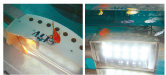 |
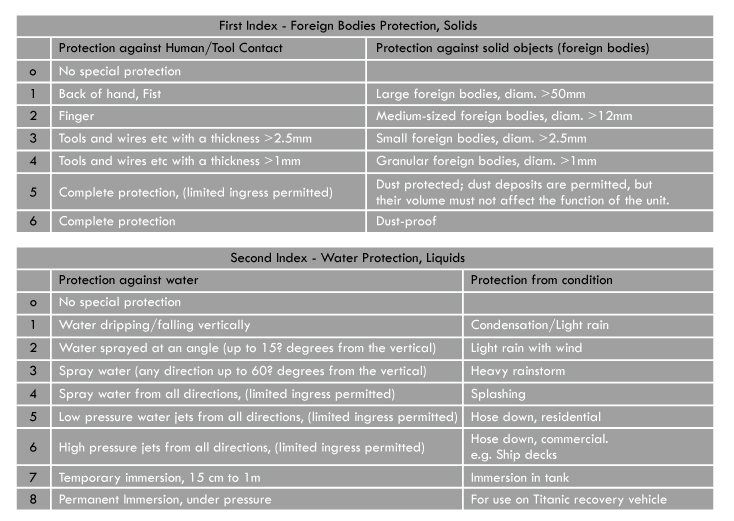
IP (INTERNATIONAL PROJECTION) followed
by two numbers, e.g. IP65. The first digit in the rating
is the protection against contact and foreign bodies.
The second digit in the rating is the water protection
factor. |
 |