DEFINITION.jpg)
What is small wind?
Small wind is not just a matter of
size. Small Wind Turbines differ from the large turbines in size, but
they also have their own operational characteristics: power, mechanics,
different sitting, a variety of customer objectives…
An
international standard defines the Small Wind category as the generators
with a swept area lower to 200m²*.
Mostly free-standing on
towers, between 10 and 20 meter height, or building-mounted and with
smaller rotor diameters, these Small Wind Turbines facilitate visual
acceptance and landscape integration in both rural and urban areas.
Their high rotational wind speed can reach 250 km/h at the blade’s tip
(or 250 to 400 rounds per minute, depending on the blade length).
How does it
work?
As the wind blows, the
generator, setting the rotor in motion, captures a percentage. This
percentage is then converted into energy: the operating rotor activates
the generator that turns mechanic energy into electric energy.
The energy produced can either be used
on-site or exported to the electricity grid: with an on-grid connection,
the generated power is totally or partially used on-site, while the
off-grid connection requires the use of batteries to supply a remote
area.
Several Small
Wind designs are available: how should you choose?
There are three dominant designs in Small Wind:
- The vertical axis wind turbine: the generator axis is vertical and
erected straight on the ground or mounted on a short tower, the blade
tips pointing toward the sky.
- The upwind horizontal axis: the generator axis is horizontal and the
turbine harnesses the wind hitting the blade first, and the nacelle or
mast afterwards.
- The downwind horizontal axis wind turbine: the generator axis is
horizontal and the turbine harnesses the wind from the back: the wind
hits the nacelle first and the blades afterwards.
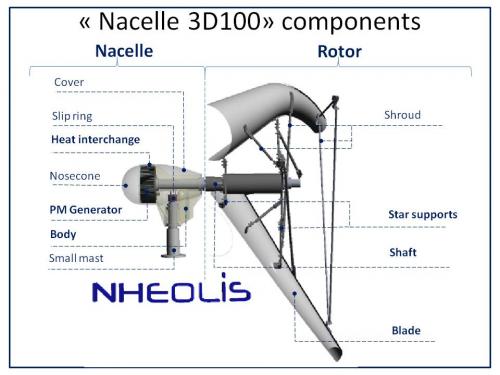
The
nheowind 3D is a downwind wind turbine. Its design fully
exploits the wind kinetic energy:
- The bottom of the cone blade captures the wind
- The nacelle design is optimized for aerodynamics.
The horizontal axis three blade wind
turbines provide better efficiency and the best technical and financial
guarantees.
Is a
wind turbine suited to your needs?
The wind potential available on your site will make the difference. Most
of time, above an annual average wind speed of 5m/s, your site is good.
However, you should have enough space to avoid local obstructions’
influence on the wind speed.
The wind turbine power curve gives
the generated power at different wind speeds. Crossing this information
with the wind distribution measured on-site, you will obtain your
potential production.
To discover available methods to assess
you site wind potential, contact us.
*IEC
61400-2
| 


